Tuesday, September 21, 2021
Building a large telescope is hard; designing a small telescope is hard. What exactly do I mean by that? Well, there are parts of the telescope that don't scale well with size, for example, the instrument payload, the filters, or the focusing actuators. More often than not, a design which works well on a 1m-class instrument fails to scale down to a 300mm-class instrument because the payload is incompatible with the mechanics, or is so large that it fills the clear aperture of the instrument.
A small telescope should also be...small. A good example of this is the remarkable unpopularity of equatorially-mounted Newtonians; a parabolic mirror with a 3-element corrector offers fast focal ratios and good performance, but an f/4 Newtonian is four times longer than it is wide, which gets unwieldy even for a 300mm diameter instrument.
The Argument for Cassegrain Focus
Prime focus instruments are popular as survey instruments in professional observatories. However, they fail to meet the needs of small instruments because of:
A Cassegrain system solves these issues by (1) allowing for moving-secondary focusing (2) roughly decoupling focal ratio from tube length and (3) moving the focal plane to be outside of the light path.
The 50% Central Obstruction
A 50% CO sounds bad, but by area the light loss is 25%, or less than half a stop. A 300mm nominal instrument with a 50% CO has the light gathering capacity of a 260mm system, which is pretty reasonable. The 50% CO also makes sizing the system an interesting exercise, because at some point the payload will be smaller than the secondary and prime focus makes sense again.
The Design
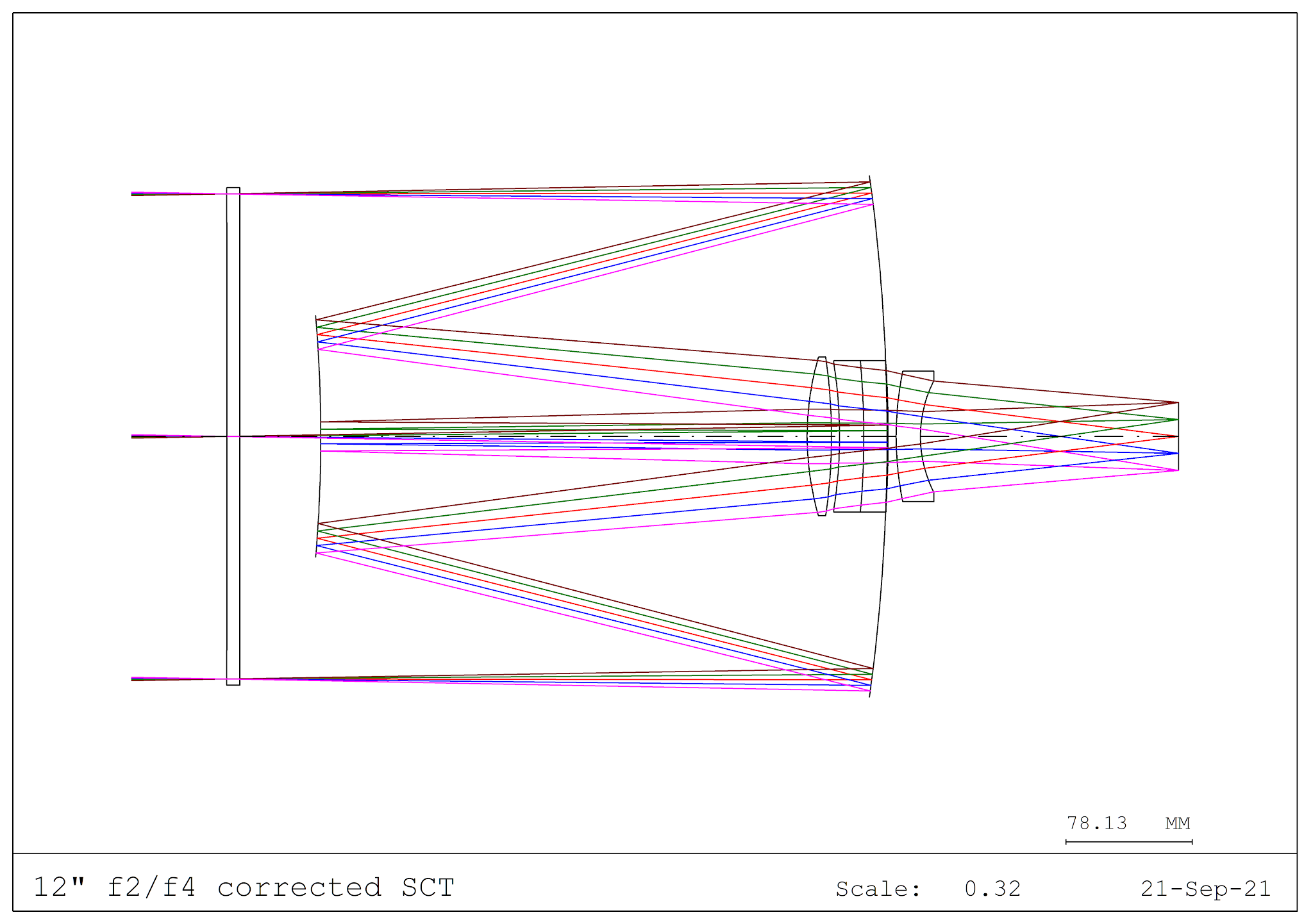
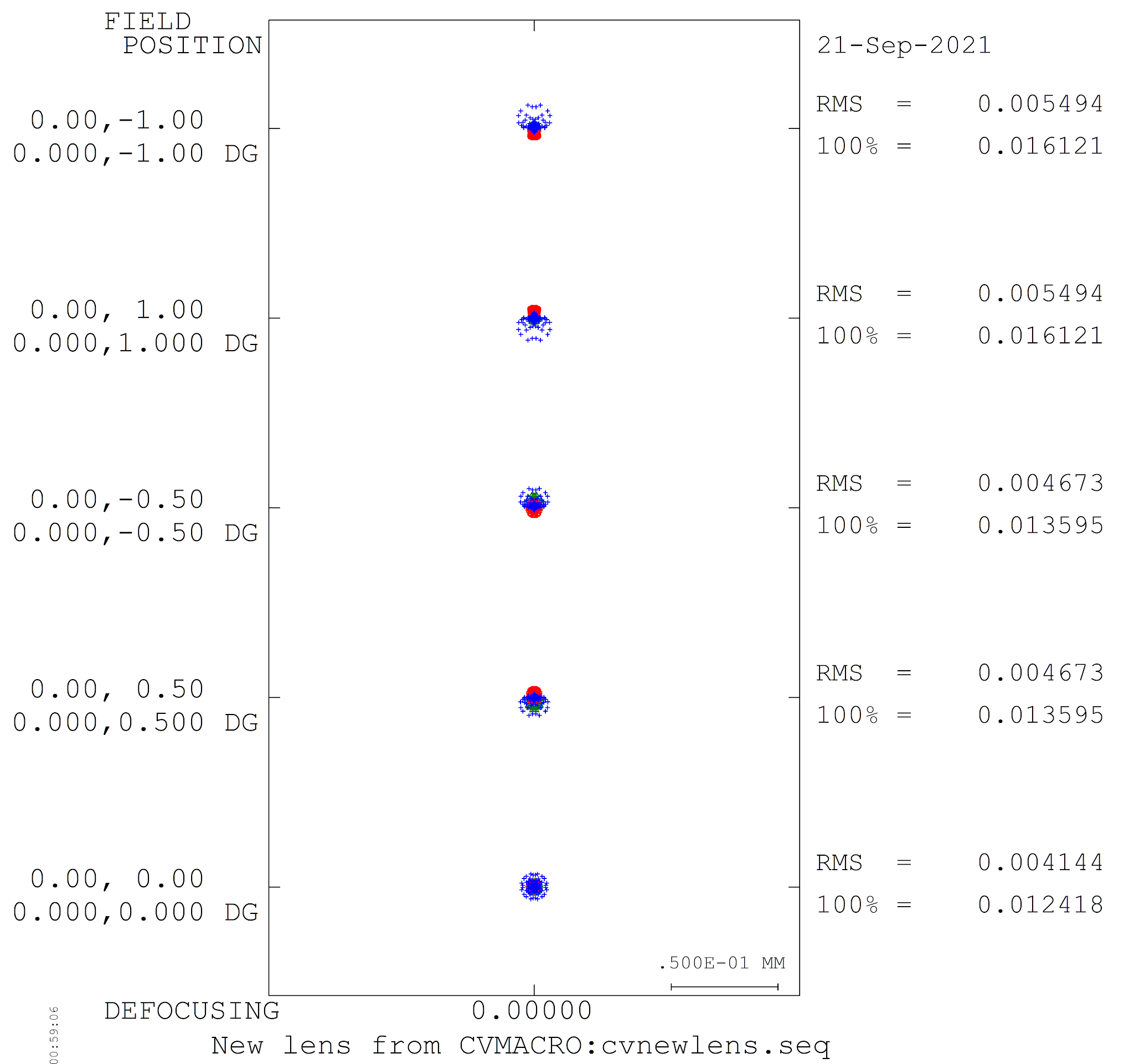
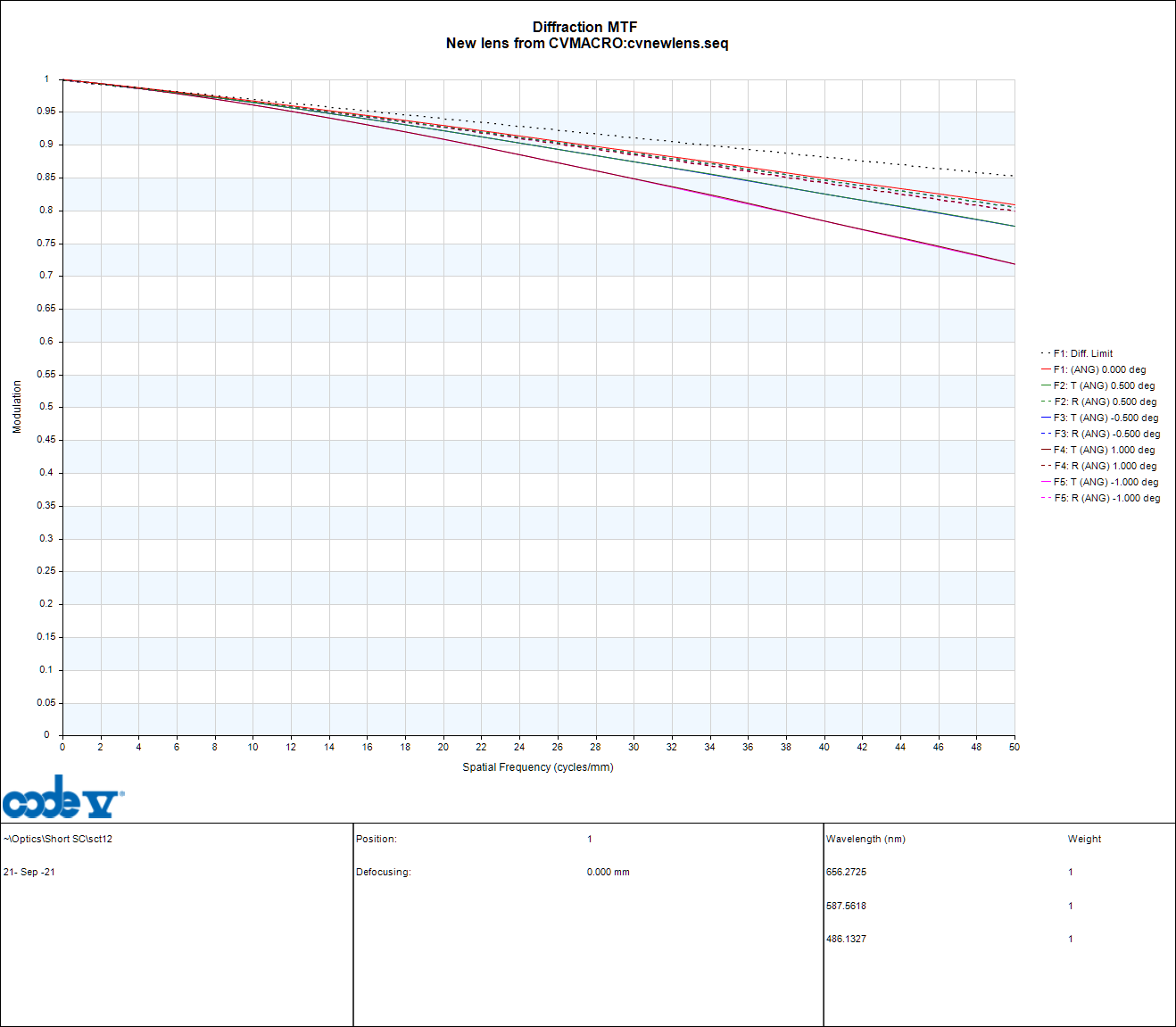
The Busack Medial Cassegrain is a really nice telescope that this design draws inspiration from, but it requires two full-aperture elements each with two polished sides that makes it ill-suited to mass production. Instead, we build the system as a Schmidt Corrector, an f/2 spherical mirror, and a 4E/3G integrated corrector. There's really nothing to it - by allowing the CO to grow and using the corrector to deal with the increasing aberrations, an f/4 SCT is entirely within the realm of possibility. There's a ton of freedom in the basic design, the present example makes the following tradeoffs:
Actually Building It?!
Obviously, you are not going to make a 300mm Schmidt corrector and a four-element, 90mm correction assembly at home. This design is probably buildable via standard optical supply chains (the hardest part would be getting someone who is neither Celestron nor Meade to build Schmidt correctors). The correction assembly should also be further improved - there are a huge number of choices for its configuration and the 'correct' one is probably the one that is most manufacturing-friendly.
Shoot me an e-mail in case you are crazy and want to do something with the prescription for this design!