View Camera Part 1
Sunday, May 1, 2016
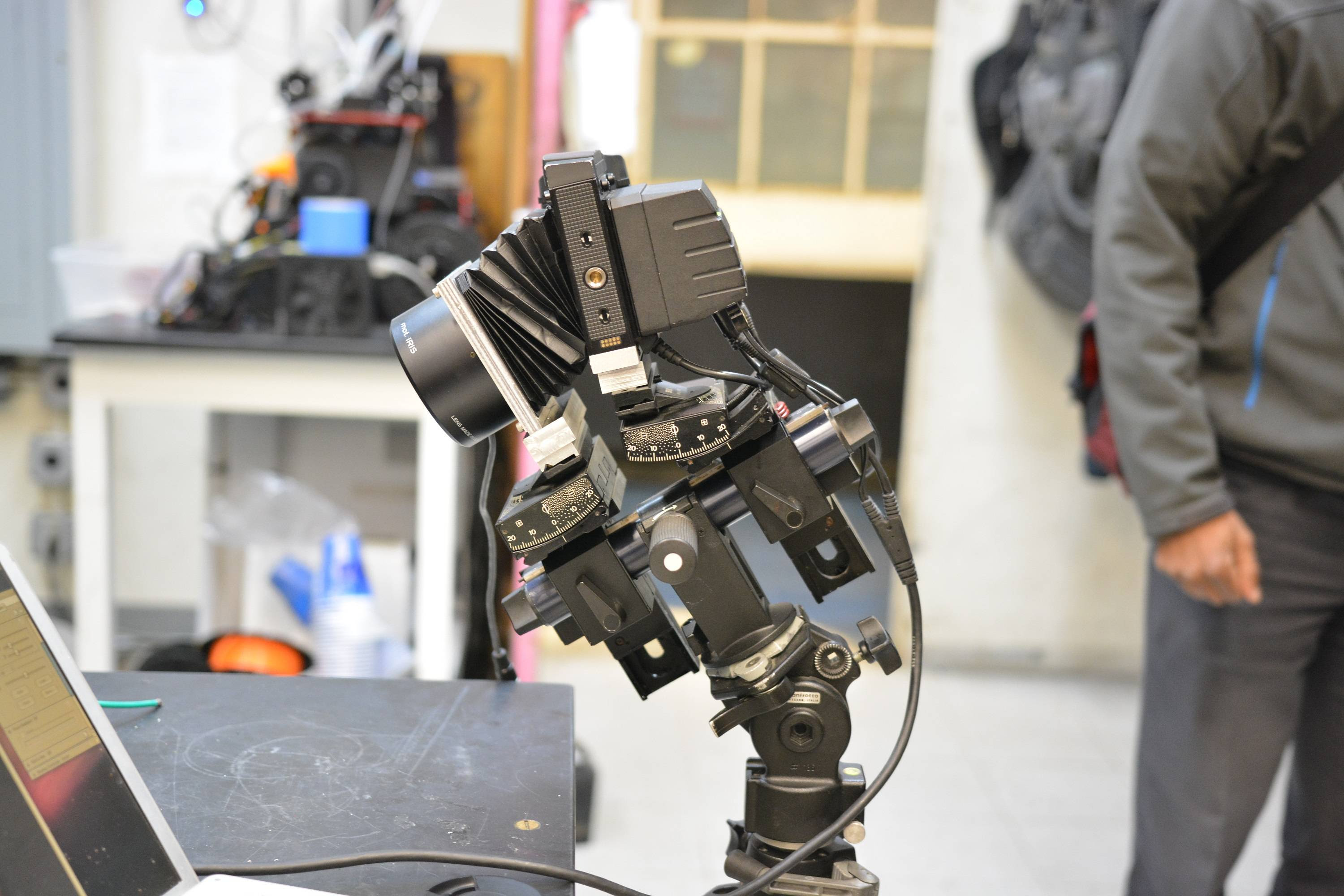
Almost as important as the picture: the picture of the thing that took the picture
I take a lot of pictures of small things. Boards, product shots, machines and the like often warrant close-ups, and taking photos at close quarters necessarily implies a shallow depth of field. I'm also a resolution freak, and like having pixel-level sharpness (after all, what good are all those extra pixels if they have no information?). This necessarily implies having a large sensor, or an exotic ultra-fast lens and lots of tiny pixels.
The problem with having a large sensor is that at close range, depth of field falls off as focal length squared, so getting everything in focus on a KAF-22000 is a lot harder than getting everything in focus on a cell phone sensor. Now, I like buttery bokeh as much as the next person, but for applications like project documentation or web store photos having a 2mm slice of your subject in focus is not really acceptable. Stopping down doesn't fix the issue either; on most modern sensors you get to stop down somewhere between f/5.6 and f/11 before diffraction screws you.
The solution (to some extent at least) is to move the plane of focus with camera movements. For a surprising number of project documentation photos, this works great; boards shots in particular look natural, with the boards entirely in focus and the Z direction of focus approximately perpendicular to the board.
This post is motivated by a couple things. There is surprisingly little documentation on tabletop type photography with medium (1:5-1:20) reproduction ratios using movements and medium format sized image areas; most things out there are focused on shift-based wide angle photography for architectural or fine art landscape work. Optimizing a camera for wide-angle work is remarkably different from building one for close-up work; the movements involved are much, much smaller (a couple degrees instead of tens of degrees) and most cameras out there are pancake-type cameras with rangefinders and focus on portability. Precision of focus is also much less important since depth of field at f/5.6 on a 35mm lens focused at tens of meters is hundreds of times larger than an f/5.6 90mm lens focused at tens of centimeters. Secondly, not a lot of material out there is focused on building a "cheap" camera (relatively speaking, of course; my system still cost $2000+ and I got real lucky on the digital back). Lastly, a lot of information out on forums is posted by idiots or brand loyalists and just plain wrong.
Camera Body
You need half-degree positioning accuracy on all movements to resolve 9-micron pixels, or quarter-degree for 4.5-micron (A7R, D800) pixels. This means gears; cameras such as the Linhof Technica series, the Fuji GX680's or any of the numerous cheap monorails will not work. And no, your Speed Graphic will not work.
Cameras with all geared movements that aren't ass expensive include:
- Sinar P/P2/X: Probably the best choice; the Sinar system is ubiquitous and the cameras are beautifully built. The X is probably a better choice than the original P simply because it is newer; the P2 is marginally better but is typically quite expensive.
- Sinar P3: This is a P2 with smaller standards. Costs about twice as much as a P2 on the secondary market, or about four times as much as the X. If you have machine shop access there is little reason to get a P3, since you won't be able to afford any of the P3-specific accessories (CMV shutters, etc) anyway.
- Cambo Legend Master: I used to have one of these; the gears aren't great and the camera is gigantic with no option to shrink because of the dovetail + L-bracket design. That being said they are dirt cheap, and form a baseline of sorts for what is acceptable.
- Cambo Ultima: I've never used one, but appears to be the same price and build quality as a P3.
- Rollei X-act2: This guy is one of two cameras (the other being the nonexistent Silvestri S5 Micron) designed from the ground up to be a digital system. It's tiny, but the accessories are expensive (albeit all easily made on a mill) and the limited range of movements are somewhat restrictive for tabletop work.
- Linhof M679cs: If you're reading this post you can't afford it.
Lenses
Lenses for digital view cameras are sort of a mystery, shrouded in BS lore and almost-as-BS marketing materials. In general, they can be divided into three classes:
- Symmetric 6-element lenses with a small image circle. This includes the Schneider Digitars, apochromatic enlarging lenses, Fujinon EBC GX lenses, and a handful of obscure 2x3 film lenses. They are usually cheap ($200-500) and resolve 9-micron pixels, but not much more. Among these the notable ones are:
- APO Componon HM 4.5/90: The highest resolution of Schneider's symmetric lens line. It out-resolves its symmetric brethren slightly, and has such features as multicoating and a fancy blue ring on the lens.
- Makro Symmar HM 5.6/120: Expensive, but the best macro choice. Even resolves 5-micron pixels as close range. Sometimes available in a barrel-type housing (aperture only, no shutter) on machine vision cameras for slightly cheaper.
- Sinaron Digital 4/80: This is a 80mm Digitar in a Sinar DB mount. Awkward to use since the DB lensboards lack an externally accessible aperture, but dirt cheap (sub-$150) and ubiquitous since it was the cheapest lens in the old Sinarcam system.
- Componons, in general, are the same optical design as the matching Digitars, but somewhat cheaper. The APO Componons are in fact the exact same lens; while the apochromatic design contributes very little to their resolving power, the modern coatings will improve contrast somewhat. That being said, they are much more expensive than their non-APO counterparts.
- GX680 system lenses are rather good; however, their electronic leaf shutters will require nontrivial hacking (which as of this post's writing no one has done) to turn on.
- Symmetric 8-element lenses based on a wide-angle design.:The lore behind these is unclear, but I've heard it said that the first generation Rodenstock Digarons (Apo-Sironar Digital) were rebranded Grandagons. These lenses have flatter fields of view than the 6-element lenses, but are rather rare and expensive. This line most notably contains:
- Apo-Sironar Digital 90/5.6: As the longest focal length of the 8-element lenses, this lens can almost resolve 5-micron pixels. Marketed as the HR Digaron-W 90/5.6, it claims to be rated for 80 MP sensors, but MTF at 100lp/mm at the corners is less than stellar.
- Retrofocus 12+ element lenses: Namely, the HR Digaron-S line of lenses. Not actually as expensive as you might think (the 100/4 is $1000 on a good day, including Copal 0 shutter). Also known as the Sinaron Digital HR. All good for 5-micron or smaller pixels. If you're using an A7R as a digital back and want any semblance of resolution, or if you have an IQ180 or a microstepping back, these lenses are more or less mandatory. It is worth noting that you will have limited movements with these lenses on 36x48mm sensors; they were designed for maximum performance on 33x44mm sensors (hence the off focal lengths such as the 60mm).
Sensor
Live view please! You'll have a miserable time focusing without it. Sadly coaxing live view out of a CCD with no electronic shutter whatsoever is exceedingly difficult. Out of the older CCD backs, Sinar has the best live view implementation, while Phase One had no live video until the P+ series. If you can afford them, the CFV-50C or the IQ3-100 are ideal, but if you are reading this post you probably can't. An alternative option is to use an A7R/II, which has a formidable, if somewhat small, sensor - this makes focusing somewhat awkward; if you want a normal focal length some cameras may not be able to focus to infinity without aggressively recessed lensboards and bag bellows.
(...more to come in the next post)